
"When you make demands on reality, sometimes you have to wait" Ben Lifson said during one of our lengthy conversations about photography in June of 2010. I was working on a long-term project photographing New York City's swimming pools and asked Ben if he would review my work every few weeks and advise me through the project (one that ended up taking three summer seasons to complete). We spoke on the telephone, Ben from Middletown, Connecticut where he was teaching at a community college and me from my apartment in the East Village where I lived while working as a photography editor at Time Inc.. I have a notebook filled with the many marvelous things Ben said, list of books I must read (Memoirs of Hadrian by Marguerite Yourcenar), painters I must study (Canaletto, the master of 'the view'), details on the structure of a sonnet as it relates to the rhythm in a picture, and on the thematic use of color in contemporary film (Irm Vep by Olivier Assayas).
Ben's passion for beauty was always expanding.
This quote by Ben surfaced from my memory last week when I opened up the New Yorker magazine (July 18-24) and saw a picture of the Naumburg band shell in Central Park at dusk by David S. Allee. Grass defines the bottom edge of the picture, and an enormous American elm tree practically fills the rest of the frame, which is aglow in greens and blues. David Allee makes picture in the field of architecture and his eye is well informed by his work in urban planning before becoming a photographer. There is always a lot to discover through his frames.
White studying the picture: four bikes tied to a rail, people in the far distance standing before the coffered limestone dome, the deep layered ridges of the elm's enormous trunk, and, to my delight, a raccoon staring back at me from the crook of the tree. What were the chances that the raccoon was present the whole time David was framing his photo? I speculated that the masked bandit had climbed the tree and was settling in for an evening of music, the perch being its 'house-seat'. I know that photographers spend countless hours behind a lens, perhaps standing on a ladder, waiting for the light, or the wind, or a moment….this is part of the craft that photographers share with painters, and journalists and what my father, the author Gay Talese, calls "the art of hanging out".
I asked David to talk about the shoot.
"That tree is surrounded by a small fenced-in area of grass and as I was approaching it I noticed the raccoon hanging around the base of the tree. He quickly climbed up the tree while I was setting up and was very curious about what I was doing, watching me while moving slowly around the lower branches. I thought it would be great to get him in the shot but the exposure needed to be at least 5 seconds and he wasn't sitting still. My assistant, Michele, pointed a flashlight to try and encourage him to move to a good spot in the frame, as well as adding a little light on him. I just kept shooting, hoping he'd sit still for 5 secs. A few times he climbed out of the frame or around to the other side of the tree but Michele and his flashlight brought him back. This went on for at least 10 to 15 minutes. Honestly I thought it wasn't going to work. But eventually, in the second to last frame, he climbed into that perfect spot in the tree at the top of the trunk and held still. I knew at that moment I got the shot.”
Today I saw a body of pictures that my brain interpreted as revolutionary.
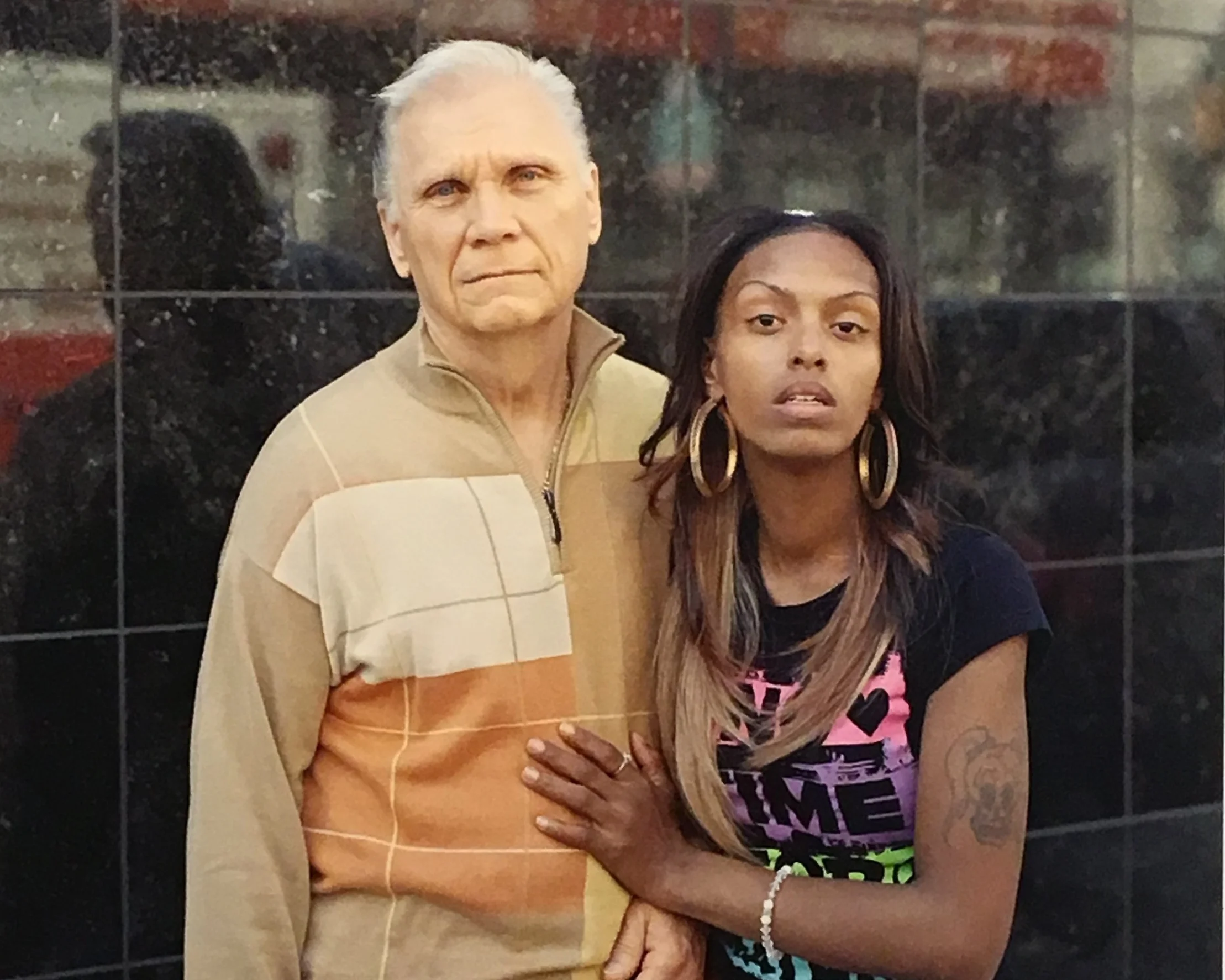
Strangers framed intimately and over time, posing as the photographer's muse until the strangers become familiars, and as familiars become united in expressions of the elemental order of man; creating a body of work that I read as an atlas of the human heart.
Richard Renaldi, the vastly skilled portrait photographer, brings his full intelligence to show us Americans unified in humanism before the backdrop of a vastly confusing time. "Touching Strangers" is a body of work that exemplifies the power of human connectivity over the economic engines that drive our nation's priorities.
El Salvador, 30 March 2017
There was a time in the early 1980s when the villagers of Cinquera, located on the northern border of El Salvador, fled from their homes. These were the early days of the violence, and the military—armed by the US—would spread terror throughout the region suppressing the civic uprising that wanted an end to repressive militarism, and called for social justice and the opportunity to earn a livable wage. The military swept through villages in death squads, massacring combatants, disappearing citizens, and filling pits with the dead. Over 75,000 people were killed during the Civil War.

With the specter of Brexit consuming the news cycle—and the darker side of our collective imaginations—it is hard not to see Homer Sykes’ photographs as windows on a little Britain that has chosen to look inward, and to abandon the experiment of a united Europe. But Sykes’ document—Once a Year: Some Traditional British Customs, reissued by Dewi Lewis 40 years after it was first published—takes a much longer view of human community, and the traditions and rituals that sustain it. Comprised of photographs taken throughout Britain in the early 1970s, Sykes seeks to capture regional rites and obscure festivals passed down across dozens of generations, many that have survived the rise and fall of nation states and endure to this day.

Richard Misrach has been photographing the American West for over 40 years; his photographs bear witness to the heroic geographic scale, and the violent imprint of the American settlement on the land. Guillermo Galindo was born in Mexico City and is an experimental composer, sonic architect, and performance artist based in California and is a Senior Adjunct Professor at the California College of the Arts, Mills College. Border Cantos is their first collaboration.

Chien-Chi Chang’s Jet Lag features photographs of the interstitial, alienating spaces of contemporary global travel, and reveals yet another unthinking system of disconnection and creeping oblivion. Available now from Hatje Cantz.

In 1956 Gordon Parks traveled to Alabama for LIFE magazine to report on race in the South. Photographing the day-to-day life of an African-American family, Parks was able to capture the tenderness and tension of a people abiding under a pernicious and unjust system of state-mandated segregation. Sixty years on these photographs still resonate with the emotional truth of the moment.
Segregation Story, photographs by Gordon Parks, introduction by Charylayne Hunter-Gault · Available February 28th from Steidl.

The following is from Notes for an Epilogue, by Tamas Dezso (text by Eszter Szablyar). Out now from Hatje Cantz.
“In this country, we had to walk, eat, sleep and love in fear.”
–Herta Müller

George Shiras is credited with taking the first-ever nighttime wildlife photographs, using a technique he developed in the early 1890s. Borrowing a hunting trick from the Objibwa called “jacklighting”, Shiras would focus a gaslight on midnight shores (across Canada and the US), waiting to capture the attention of the forest inhabitants with his strange alien moon. He also developed photographic “traps,” remote-triggering snares to capture animals in action, in the depths of the wood.
The following images are collected in a new photographic edition from Editions Xavier Barral, called George Shiras: In the Heart of the Dark Night, by Jean-Christophe Bailly.